This is part of a series on EigenDA V2. Previous posts covered EigenDA’s architecture and custom-built DB, LittDB.
Data availability systems face a fundamental tension: validators need to attest that data is available, but storing complete copies across hundreds of nodes doesn't scale.
EigenDA solves this by splitting the problem in two. Reed-Solomon erasure coding lets validators store only fragments while preserving reconstructability. KZG polynomial commitments let anyone verify those fragments are legitimate without downloading everything.
This post is about making that work at 100MB/s+. We'll cover which cryptographic primitives EigenDA uses, where the encoding pipeline spends its time, and how GPU acceleration via Ingonyama's ICICLE library turns cryptographic theory into production infrastructure.
What Encoding Does
Before a blob can be dispersed across EigenDA's validator set, it has to be encoded and transformed from raw bytes into something that can be sharded, verified, and reconstructed.
The encoder is a component of dispersers that handles this encoding. It takes a blob as input and produces 8,192 frames as output, where each frame is a tuple of {chunk, proof}. Chunks are what validators store; proofs are what let them verify their chunk belongs to the original blob without seeing the whole thing.
This is what makes EigenDA's security model work: validators only hold fragments, but anyone can verify those fragments are legitimate and reconstruct the original data from a subset of them.
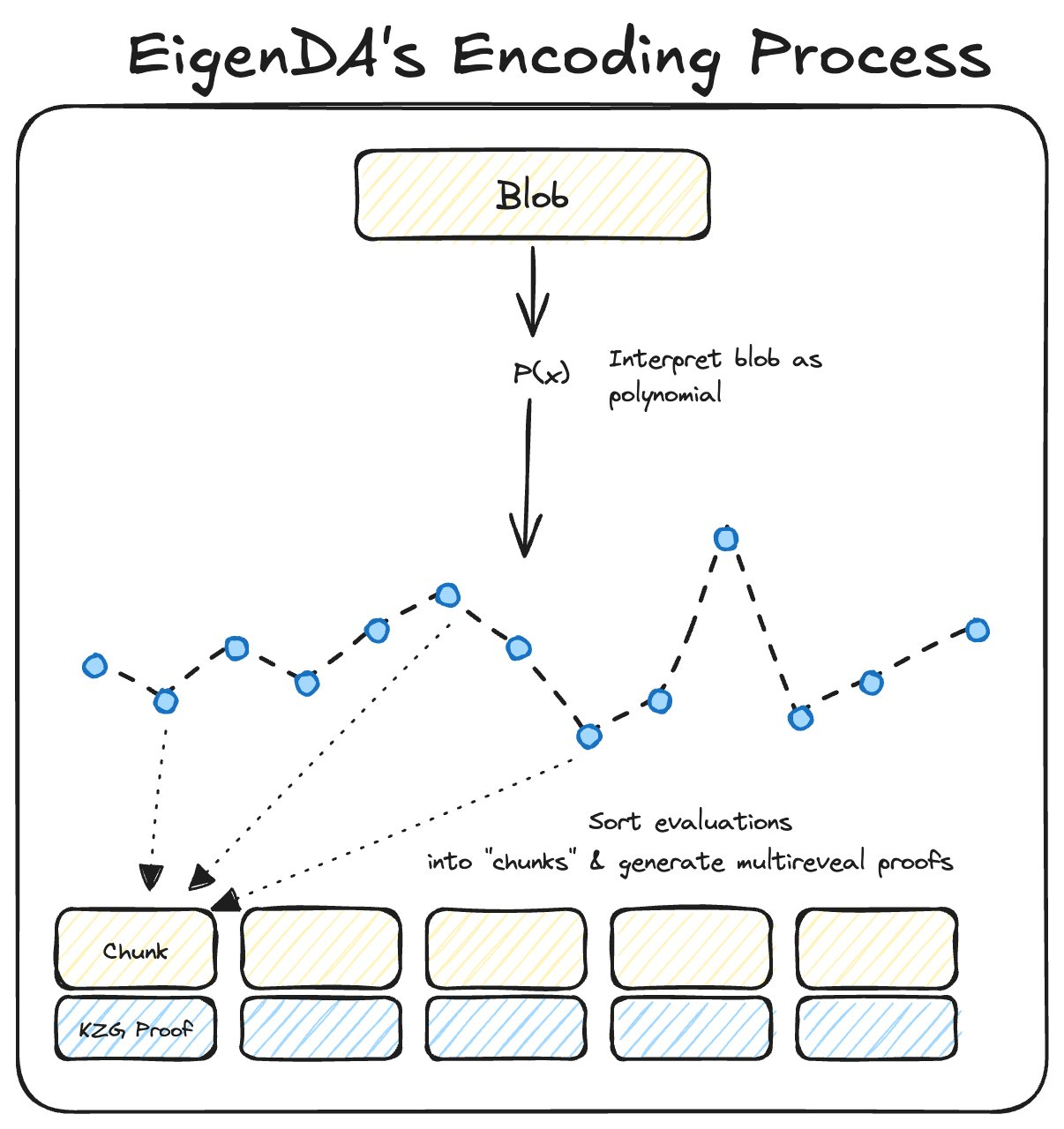
To achieve these properties, the encoder implements two cryptographic primitives:
- Reed-Solomon erasure coding expands the blob and shards it so that any sufficiently large subset of chunks can reconstruct the original.
- KZG polynomial commitments (with Fast Amortized KZG Proofs for efficient multiproof generation) let each validator verify their chunk against a single blob commitment, without downloading the full blob.
This is a similar Reed-Solomon + KZG construction to Ethereum's Danksharding design, adapted for BN254 and scaled for 100+MB/s to GB/s+ throughput.
Client Side KZG Commitments
Before a blob reaches the disperser, the client generates KZG commitments (blob commitment, length commitment, and length proof) from the original data. This commitment is included in the signed blob header sent to the disperser. Like a sealed envelope, the commitment is created before dispersal, so the disperser cannot tamper with the data without detection. Later, anyone can verify that the chunks and proofs match the original commitment, ensuring data integrity without trusting the disperser.
The rest of this post is about how we make that fast: where the encoding pipeline spends its time, why GPUs matter, and how ICICLE gets us to production performance.
For a complete specification of these properties check out the EigenDA spec.
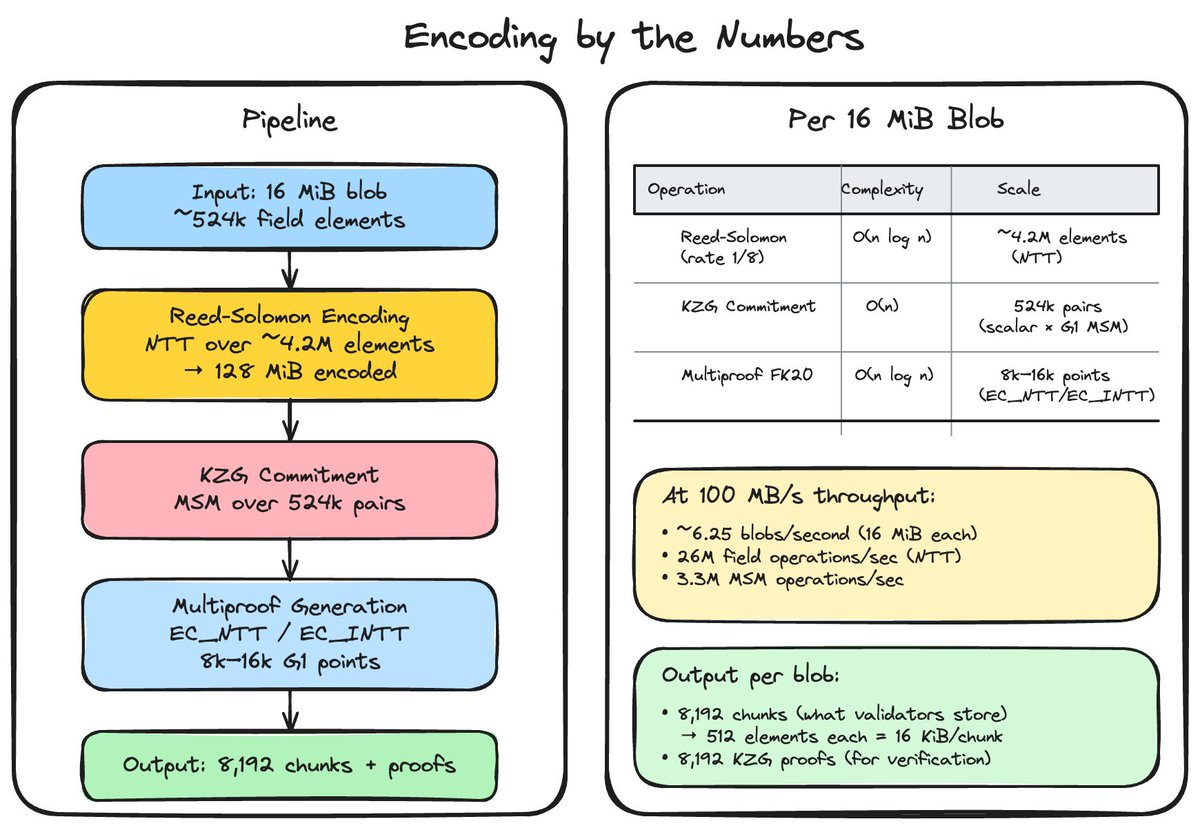
Encoding by the Numbers
For each blob, the disperser produces two outputs:
- Chunks (what validators store)
- KZG multiproofs (what validators use to verify their chunks).
To see why GPU acceleration matters, it helps to have a concrete blob in mind.
Parameter cheat sheet:
- Max blob size: 16 MiB
- Field representation: 16 MiB ≈ 524,288 BN254 field elements
- Reed-Solomon coding: Rate 1/8 → blob expands to 128 MiB encoded
- Chunks: 8,192 total (1,024 original + 7,168 parity)
- Chunk size: 512 field elements (16 KiB) each
What this means for compute:
One 16 MiB blob triggers roughly:
- Reed-Solomon encoding: NTTs over ~4.2 million field elements
- KZG commitment: One MSM over ~524,288 scalar x G1 pairs
- Multiproof generation (FK20): EC_NTT / EC_INTT over 8k–16k G1 points
At 100 MB/s, the system is doing this continuously, for every blob sent to EigenDA. In the next section we’ll look at how these parameters show up in the encoding pipeline, and why EC_NTT, EC_INTT, and MSM are exactly the operations we hand to the GPU.
For every additional 10 MB/s of throughput, the encoder must handle roughly 2.6 million more field element operations and proportionally more elliptic-curve arithmetic per second.
The Encoding Pipeline - Chunks & MultiProofs
EigenDA's encoding is split into two pipelines that run for every blob: one generates the 8,192 chunks, while the other generates the KZG multi-reveal proofs for each chunk.
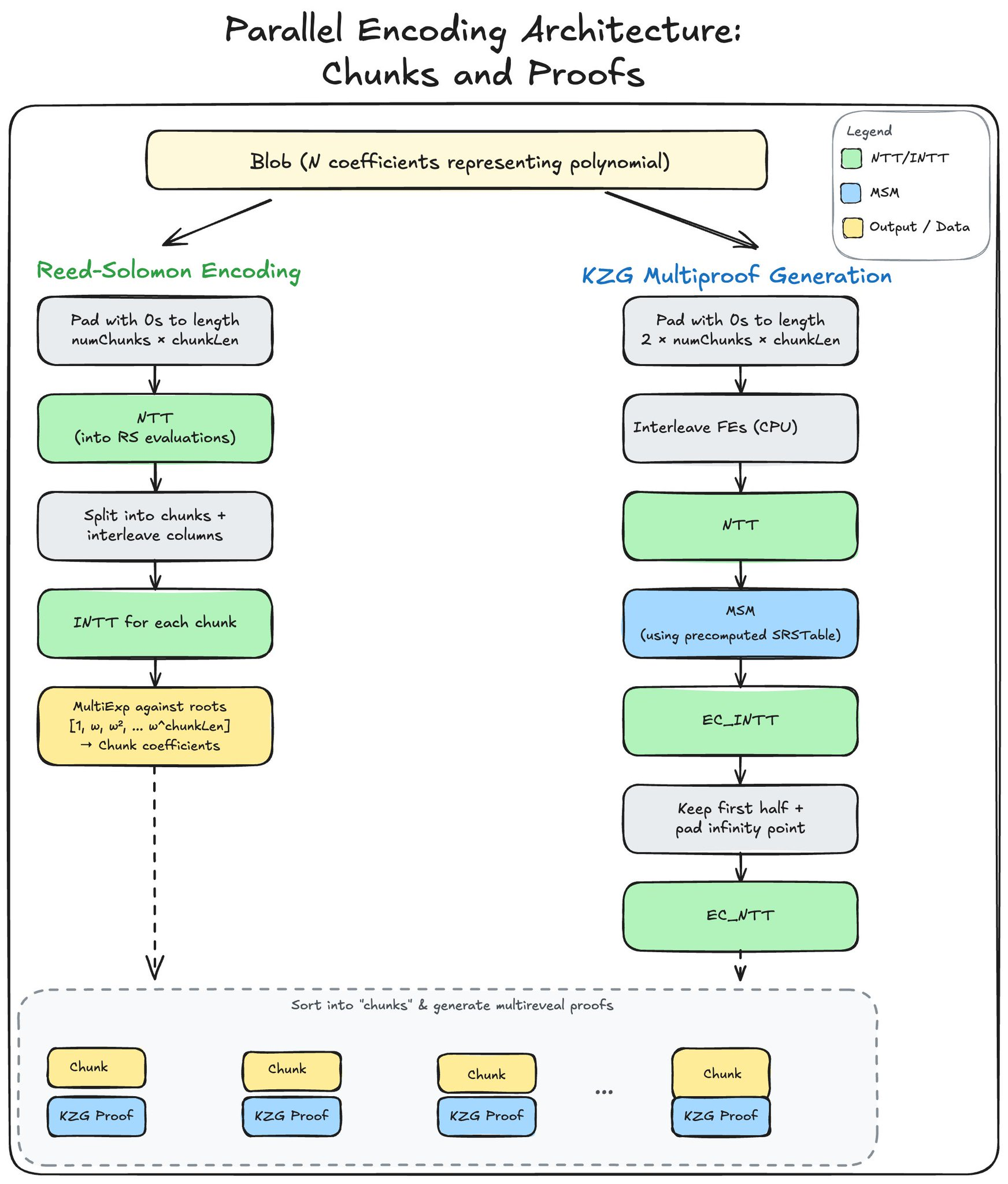
At a high level, there’s 3 kinds of operations in these pipelines:
MSM (Multi-Scalar Multiplication)
Combines many elliptic curve points weighted by scalars into a single sum, forming the core of KZG multiproof generation.
NTT / ECNTT (Number-Theoretic Transform / Elliptic Curve NTT)
A Fast Fourier Transform over finite fields or curve points that efficiently evaluates polynomials for encoding and proofs.
Scalar Operations
Array operations like padding, interleaving, and butterfly steps that prepare data for NTT computations.
Reed-Solomon Encoding Pipeline
This pipeline takes a blob and produces 8,192 chunks that validators will store. It expands the blob 8x using forward FFT (NTT) to create erasure-coded evaluations, then splits them into 8,192 chunks by converting each chunk's evaluations back to polynomial coefficients via inverse FFT.
KZG Multiproof Generation Pipeline
The KZG multiproof generation pipeline takes a blob (polynomial coefficients) and produces 8,192 KZG proofs (one per chunk) by computing Toeplitz matrix coefficients via NTT, performing MSM against precomputed SRS points, then applying two NTT operations (inverse then forward) to transform the results into the final proof evaluations.
The most expensive operations across both pipelines are MSM, EC_NTT, and EC_INTT all elliptic curve arithmetic that dominates encoding time.
GPU Acceleration with Ingonyama ICICLE
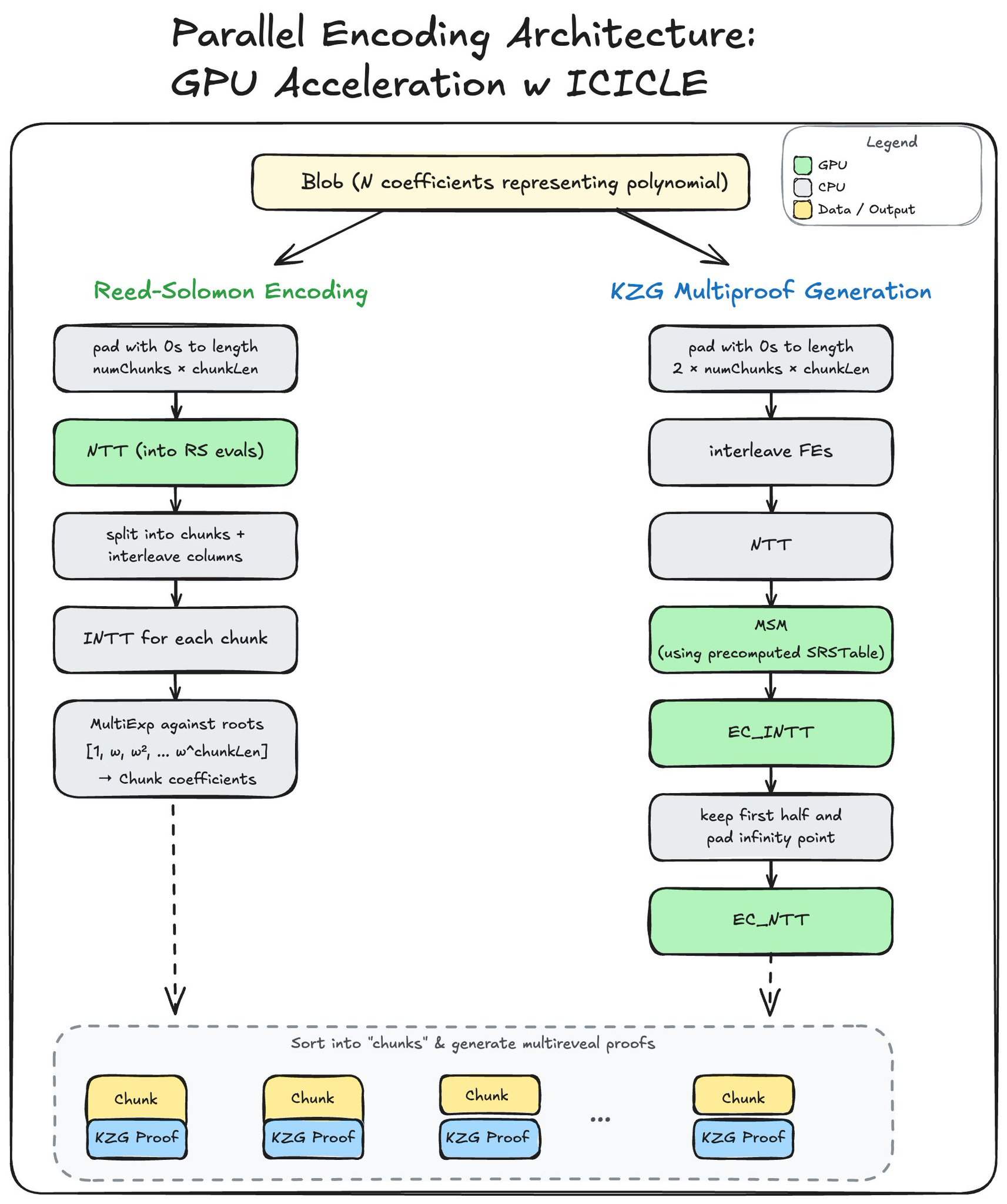
To meet EigenDA's performance targets, we accelerate these three operations using Ingonyama's ICICLE library, a hardware acceleration library for compute-intensive cryptography. ICICLE provides GPU-optimized implementations for the elliptic curve operations that bottleneck EigenDA's encoding.
Selective Acceleration
We don't GPU-accelerate everything. We only offload operations where the shape of the work plays to GPU strengths: large input sizes, regular structure, and heavy elliptic curve arithmetic.
Those criteria pick out exactly three hotspots, all in the KZG multiproof pipeline:
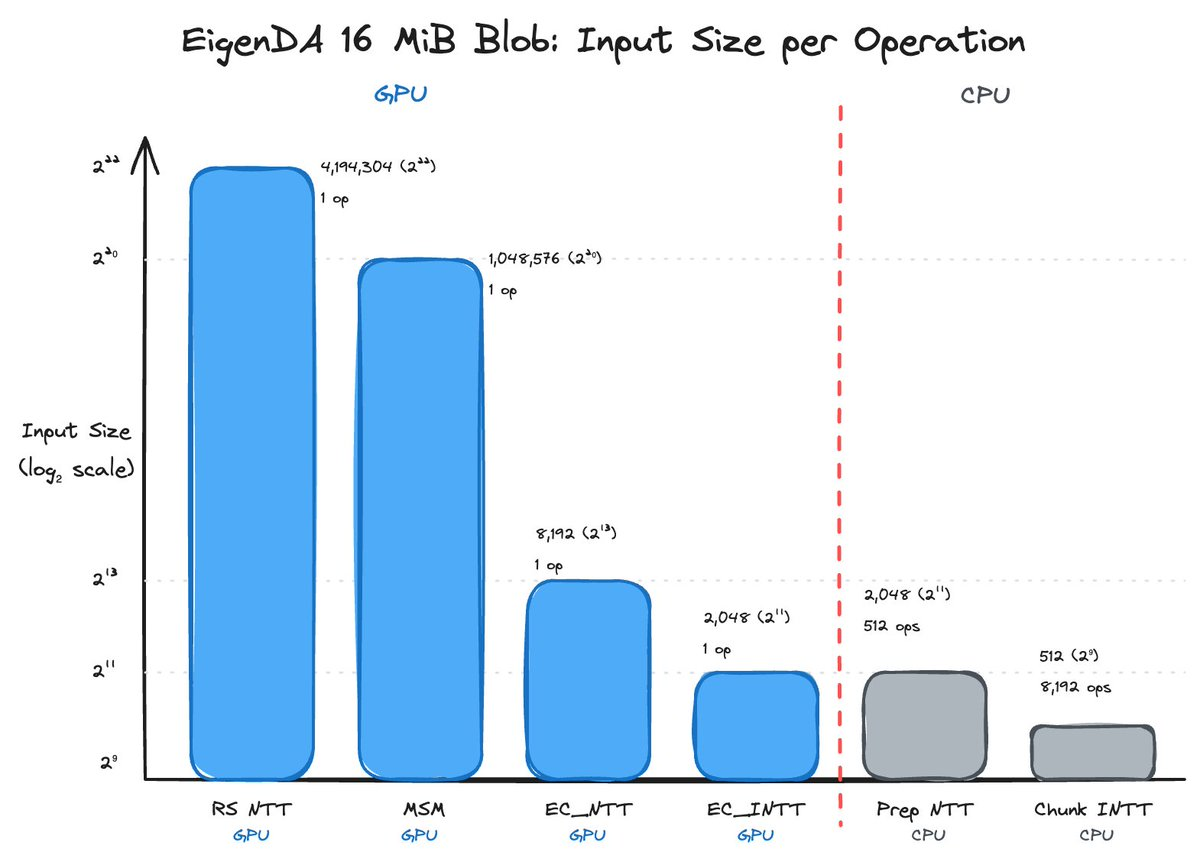
In contrast, the field-element NTTs in the Reed-Solomon path are structured differently: 8,192 independent transforms of just 512 elements each. For this pattern, GPU kernel launch overhead dominates, while CPUs handle small cache-friendly loops efficiently. So we keep those on CPU—simpler, cheaper, fast enough.
Performance
With this split, encoding a max-size 16 MiB blob on a single encoder looks like:
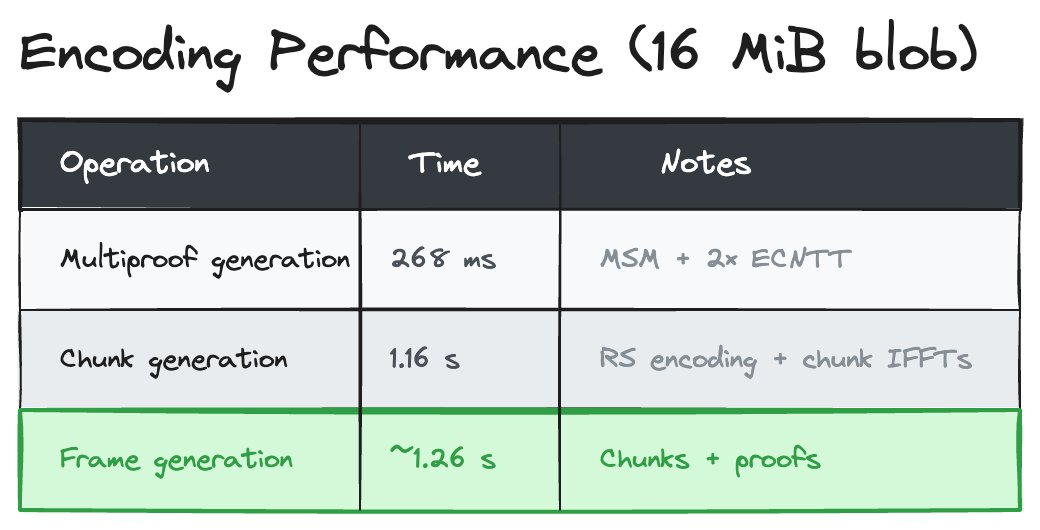
This puts encoding comfortably within the budget needed to sustain 100+ MB/s network throughput. For context: encoding a 128 KiB blob with CPU-only takes ~8.2 seconds. Even at 1/128th the size, that's a 56× slowdown per-byte compared to our GPU-accelerated 16 MiB encoding. The gap widens as blobs scale and GPU is our path to a production-ready system.
Optimizing Multiproof Generation with Toeplitz Matrices
The KZG multiproof pipeline has one more optimization worth calling out, one that delivers an 8× speedup for typical blobs.
In the multiproof generation step, we multiply a special matrix called a Toeplitz matrix by a vector, then run an FFT on the result. A Toeplitz matrix has a useful structure: every diagonal contains the same value, so the whole matrix is defined by just its first row and column.
This structure lets us use an FFT-based algorithm instead of naive matrix multiplication, O(n log n) instead of O(n²). But our original implementation had room for improvement.
The waste: We sized the Toeplitz matrix for the maximum 16 MiB blob (8,192 × 8,192), even when processing smaller blobs. A 1 MiB blob only fills ~512 rows with real data. The rest is zeros and we were paying to multiply and FFT all of them.
The fix: Size the Toeplitz matrix to the actual blob size. Multiply only the "live" submatrix, pad zeros afterward, then FFT. Mathematically identical but now proof generation cost scales proportionally with blob size. If you want to learn more about Toeplitz Matrices, you can read this article.
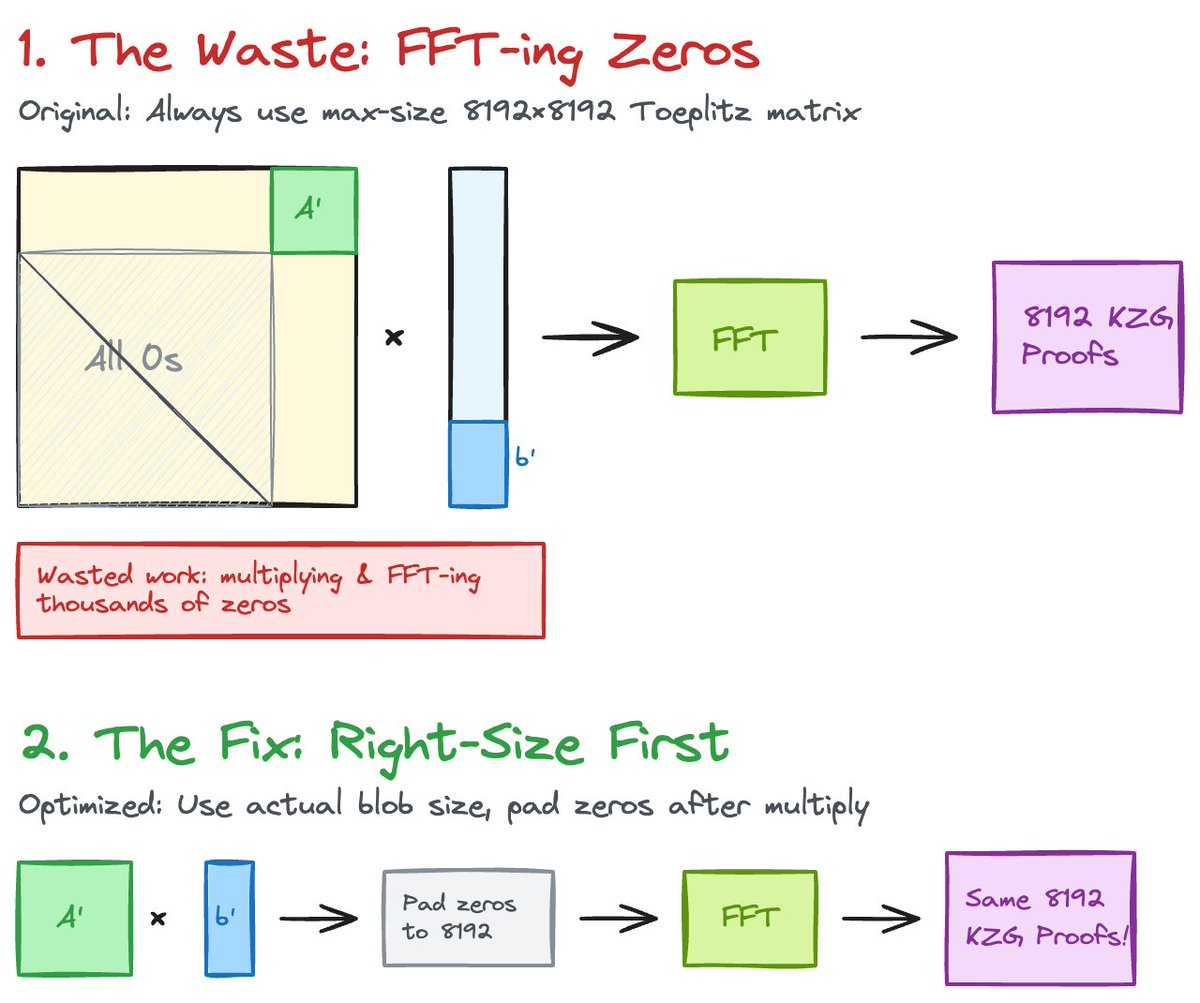
The result: both the MSM stage and the first FFT in multiproof generation see 8× speedups for typical blob sizes, dropping end-to-end proof generation from seconds to sub-second.
Bringing Encoding Together
Production-grade data availability requires three things: cryptographic guarantees, hardware acceleration, and systems that scale. EigenDA delivers all three. Reed-Solomon encoding provides redundancy. KZG commitments enable trustless verification. And Ingonyama's ICICLE library accelerates the elliptic curve operations that bottleneck encoding with MSM, EC_NTT, and EC_INTT. The result: 16 MiB payloads encoded in ~1.26 seconds, 100 MB/s sustained throughput, and a path to GB+/s. Cloud-scale DA infrastructure, ready today.
Watch the 1GB/s post to learn more about EigenDA's path.